
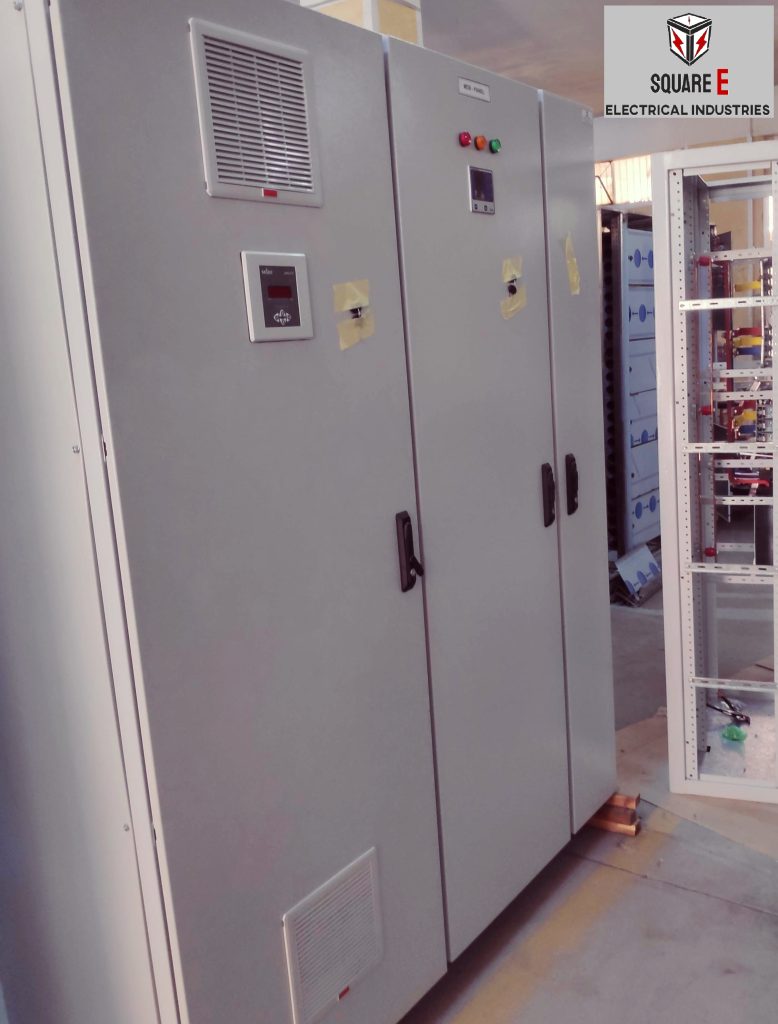
Maximize Efficiency, Minimize Costs
Our Power Factor Correction (PFC) Panels are essential for industrial and commercial facilities looking to optimize their electrical consumption. By automatically compensating for reactive power, these panels improve the efficiency of your electrical system, stabilize voltage, and—most importantly—eliminate the “low power factor” penalties often imposed by utility providers.
-
General Description: An intelligent capacitor bank system that monitors the phase shift between voltage and current. When it detects an inefficient “Lagging” power factor (common in facilities with many motors or transformers), it automatically switches capacitor steps into the circuit to bring the power factor closer to unity ($1.0$).
-
Key Technical Specs:
-
Compensation Type: Automatic multi-step compensation using a dedicated Power Factor Controller.
-
Step Configuration: Custom-designed steps (e.g., 5, 10, 25, or 50 kVAr) to provide precise regulation based on real-time load changes.
-
Capacitors: High-duty, heavy-purpose dry-type or oil-filled capacitors with self-healing technology and overpressure disconnector safety features.
-
Detuned Reactors: Optional high-quality reactors (7%, 14%, etc.) to protect capacitors from harmonic distortion and prevent resonance in the electrical network.
-
-
Intelligent Control & Safety:
-
Smart Controller: Microprocessor-based regulator with a digital display showing $cos \phi$, current, voltage, and total harmonic distortion (THD).
-
Switching Components: Specialized “Capacitor-Duty” contactors equipped with pre-charge resistors to handle high inrush currents and extend the lifespan of the system.
-
Protection: Each capacitor step is independently protected by HRC fuses or MCBs to ensure system continuity if one step fails.
-
-
The Benefits for Your Facility:
-
Reduced Utility Bills: Eliminates reactive power charges and penalties on your monthly electricity bill.
-
Increased System Capacity: By reducing the total current (kVA) demand, you free up capacity on your existing transformers and cables for additional loads.
-
Heat Reduction: Lowers $I^2R$ losses in cables and transformers, leading to cooler operation and longer equipment life.
-
Voltage Stability: Improves the voltage profile at the end of long cable runs, ensuring more reliable operation of sensitive machinery.
-